French Drain Installation on the Connecticut Shoreline
Drainage Pro of CT installs French drain systems that intercept subsurface water and move it safely off your property. We are the dedicated French drain contractors serving residential properties across all 13 towns on the Connecticut Shoreline.
We will get back to you as soon as possible.
Please try again later.
LICENSED & INSURED
HIC#0706616
5-YEAR WORKMANSHIP WARRANTY
What Is a French Drain and How Does It Work?
A French drain is a trench filled with drainage stone and a perforated pipe, designed to collect subsurface water and redirect it away from your property to a safe discharge point. The concept works on a simple principle: water follows the path of least resistance. By creating a gravel-filled channel with a pipe at the bottom, you give water an easier path than saturating your lawn, pooling in your yard, or pressing against the outside of your foundation wall.
The execution is where expertise makes all the difference. A French drain system must be installed at the correct slope, typically one percent grade or about one inch of drop per eight feet of length. Too flat and the water sits in the pipe and stagnates. Too steep and it moves too fast, eroding the system from the inside over time. The pipe must be the right diameter for the volume of water your property generates. The drainage stone must be the right size and type. The filter fabric must keep soil particles out without restricting water flow into the pipe. And the discharge point must be planned carefully so the water exits your property without creating a new problem somewhere else on your land.
Getting any one of these details wrong is exactly why French drains installed by landscapers and general contractors fail within a few seasons. We get them right because French drain installation is all we do, and we have been doing it across the Connecticut Shoreline long enough to know how every soil type and water table condition in this region behaves.
Signs You May Need a French Drain on Your Property
Not every drainage problem on your property requires a French drain, but the situations below are the ones where a properly installed French drain system is almost always the right solution. If any of these sound familiar, it is worth calling us for a free assessment.
Standing Water in Your Yard That Lasts More Than 24 Hours After Rain
If water is still pooling in your yard a full day or more after a rainstorm, your soil is saturated and has no outlet. This is one of the clearest signs that your property needs a French drain system to intercept that water and give it a path off your land. We see this regularly in the lower lying lots throughout Westbrook, Clinton, and the residential neighborhoods of East Haven.
Damp or Wet Exterior Foundation Walls
Moisture appearing on the outside of your foundation wall, particularly along the lower portion, often indicates hydrostatic pressure from groundwater saturating the soil directly against your building. A French drain installed along the exterior foundation perimeter intercepts that water before it reaches the wall and routes it away from the building entirely. This is exterior work, addressing the source of the pressure on the outside rather than managing symptoms on the inside.
A Persistently Soggy Area That Never Fully Dries
A section of your lawn that stays soft and wet even when the rest of your property has dried out is sitting above a high water table zone or a natural subsurface water channel. A French drain positioned to intercept that water below ground pulls it away from the area and routes it to a discharge point. We install French drains for exactly this condition on properties throughout Killingworth, North Branford, and Durham, where elevated terrain pushes groundwater into low spots on residential lots.
Efflorescence on Your Foundation Wall
The white, chalky mineral deposits that appear on concrete or masonry foundation walls are called efflorescence, and they are a sign that water has been moving through the material from the outside. The water carries minerals with it, and when it evaporates on the surface it leaves those minerals behind as a visible residue. If you are seeing efflorescence on your exterior foundation wall, groundwater pressure is working against your building and a French drain system is one of the most effective exterior solutions available.
Water Pooling Against Your Foundation After Rain
If water consistently collects at the base of your foundation after a rainstorm and does not drain away within a few hours, your property's grade and subsurface drainage are not moving that water the way they should. In many cases along the Connecticut Shoreline, particularly in older neighborhoods throughout Guilford, Essex, and Old Lyme, this condition has developed over years as landscaping has matured and soil has settled. A French drain along the foundation perimeter is often the right solution, and it is sometimes paired with exterior foundation waterproofing for a complete result.
Our French Drain Installation Process
Every French drain installation we complete begins with a thorough on-site assessment. We walk your property, identify water sources and flow patterns, evaluate soil conditions, and design the system before we break ground. Here is what the full installation involves from start to finish.
Step 1: Site Assessment and System Design
We map the water flow across your property, determine the path the French drain will follow, identify the discharge point, and calculate the pipe diameter and trench depth required. This step is what prevents expensive corrections mid-project and ensures the system we install is designed for your specific property conditions, not a generic layout applied to every job we take.
Step 2: Trenching
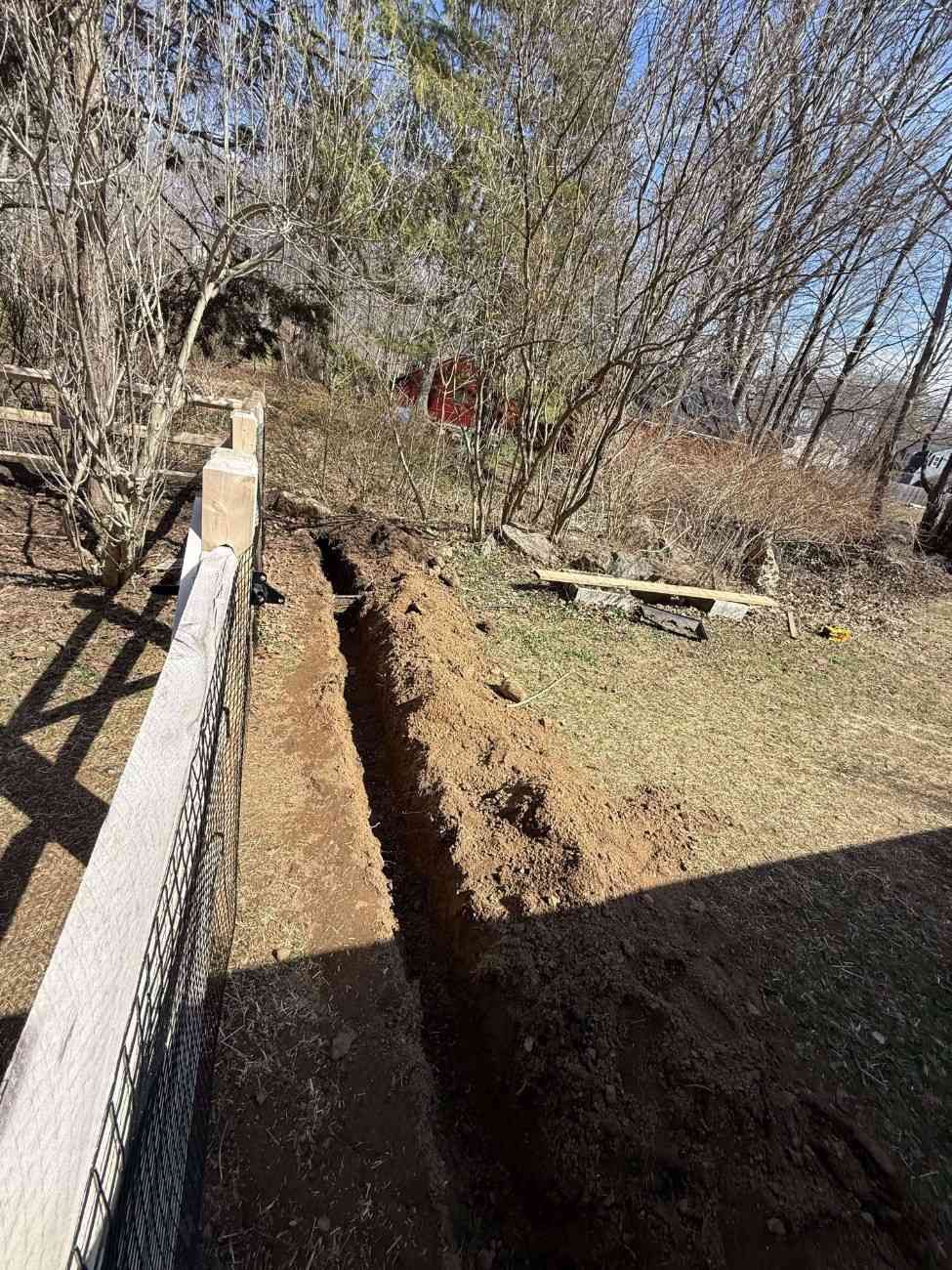
We excavate a trench along the designed path, typically 18 to 24 inches deep and 12 inches wide. For French drains installed along a foundation perimeter, we may excavate deeper to reach the footing level depending on the conditions your property presents. All excavation is done with equipment sized appropriately for your yard and access conditions.
Step 3: Filter Fabric and Stone Bed
The trench is lined with filter fabric rated for drainage applications. This fabric allows water to pass through freely while preventing soil particles from migrating into the drainage stone and clogging the system over time. A base layer of clean, open-graded drainage stone is then placed at the bottom of the trench to create the bed the pipe will rest on.
Step 4: Perforated Pipe Installation
The perforated drainage pipe is laid on the stone bed at the correct slope, with perforations oriented to collect water from below and around the pipe. Pipe diameter is selected based on the volume of water the system needs to handle. We use smooth wall PVC perforated pipe on all installations, which maintains flow capacity far longer than corrugated pipe and is the standard we hold every French drain system to.
Step 5: Backfill and Grading
The trench is filled with drainage stone to within a few inches of the surface, the filter fabric is folded over the top of the stone to complete the envelope, and topsoil is placed to restore the surface grade. Seed or sod is applied to restore the lawn surface to match the surrounding area. We do not leave your property looking like a drainage crew was just there.
Step 6: Discharge Point Installation
The pipe terminates at a planned discharge point that carries the collected water safely off your property. Depending on your property's layout and local requirements, this may be a daylight outlet where the pipe exits on a downhill slope, a dry well that disperses water into the soil at a safe distance from your building, or a catch basin connected to a storm drain where permitted. The discharge point is planned at the design stage, not figured out at the end.
How Much Does French Drain Installation Cost in Connecticut?
French drain installation on the Connecticut Shoreline typically costs between $3,000 and $6,000. The final price depends on the length of the drain run, the depth required to reach the water table or footing level, soil conditions (rocky soil found on many Killingworth and Durham properties costs more to excavate than the sandier coastal soils found in Westbrook and Clinton), the number of discharge points the system requires, and the extent of landscape restoration needed after installation.
French drain installation on the Connecticut Shoreline typically costs between $3,000 and $6,000. The final price depends on the length of the drain run, the depth required to reach the water table or footing level, soil conditions (rocky soil found on many Killingworth and Durham properties costs more to excavate than the sandier coastal soils found in Westbrook and Clinton), the number of discharge points the system requires, and the extent of landscape restoration needed after installation.
We provide free on-site estimates with exact pricing before any work begins. No surprises, no hidden fees, and every French drain installation is backed by our 5-year workmanship warranty. If we encounter something genuinely unexpected underground during the project, we discuss it with you before proceeding. We do not issue change orders without a conversation first.
French Drain vs Curtain Drain: Which One Does Your Property Need?
French drains and curtain drains are similar in how they are built but different in what they are designed to do, and choosing the wrong one means solving the wrong problem.
A French drain collects water that is already present around a problem area, such as saturated soil along your foundation perimeter or a low-lying section of your yard that holds water after rain. It intercepts that water where it sits and routes it to a discharge point.
A curtain drain is positioned uphill from the problem area and intercepts water that is flowing toward it before it arrives. If water is moving onto your property from a neighboring lot, from a hillside above your yard, or from a sloped area that drains toward your building, a curtain drain placed across that flow path stops the water before it reaches the zone causing you trouble.
In some cases, particularly on the hillside properties of Killingworth, Durham, and North Branford, both systems are needed together. The curtain drain stops incoming water from uphill, and the French drain manages what is already present in the problem zone.
Our on-site assessment determines which solution fits your specific property conditions. We do not recommend a French drain system when a curtain drain is what your property actually needs, and we do not recommend a curtain drain when the water source is already on your land.
Frequently Asked Questions About French Drain Installation
How long does a French drain last?
A properly installed French drain system with the right materials lasts 20 to 30 years or more. The factors that determine longevity are correct slope, appropriate filter fabric, clean open-graded drainage stone, and a properly planned discharge point. French drain systems installed by non-specialists using the wrong materials or an incorrect slope often fail within two to five years, which is why choosing a dedicated French drain contractor near you matters more than the upfront price.
Can a French drain be installed in winter?
Yes, in most cases. Winter installation is possible when the ground is not frozen solid. Connecticut winters vary significantly, and during mild stretches we install French drains throughout the colder months. Frozen ground may delay scheduling during the coldest weeks of January and February, but we work through winter on most projects across our 13-town service area.
Will a French drain fix the water problem at my foundation?
In many cases, yes. If water is pressing against your exterior foundation wall due to saturated soil, an exterior French drain along the foundation perimeter intercepts that water before it reaches the wall and routes it away from the building. This is an exterior solution addressing the source of the problem on the outside of your building. For properties where the water pressure against the foundation is significant, we sometimes recommend pairing a French drain with exterior foundation waterproofing for a complete result.
What is the difference between a French drain and a trench drain?
A French drain is buried below ground and collects subsurface water through a perforated pipe set in a gravel bed. A trench drain, also called a channel drain, is a surface-mounted linear drain that collects water flowing across hard surfaces such as driveways, patios, and parking lots. They solve different problems and are often used together on the same property for complete exterior water management. If you are unsure which one your property needs, our free on-site assessment will identify the right solution.
What is the best way to find a professional to install a French drain for basement moisture control in Connecticut?
The best way to find a qualified French drain installer in Connecticut is to look for a drainage-dedicated contractor, not a general landscaper or handyman, who works specifically on exterior drainage systems. Exterior French drains intercept water in the ground before it ever reaches your foundation wall, which means the installer needs to understand soil conditions, proper pipe slope, drainage stone sizing, and filter fabric selection. A general contractor may install pipe, but a drainage specialist installs a system that actually works long-term.
We are a drainage-dedicated contractor serving the Connecticut Shoreline, licensed under HIC#0706616 and fully insured. We back every French drain installation with a 5-year workmanship warranty. Every job starts with a free on-site assessment where we trace where water is entering your property, diagnose the cause, and recommend the correct solution, whether that is a perimeter French drain, an exterior foundation drainage system, or a combination of both. We serve 13 towns including Clinton, Guilford, Madison, Branford, Old Saybrook, East Haven, and surrounding areas.
To schedule a free estimate, call (860) 852-6270 or visit drainageproofct.com.
How does French drain installation compare to dry wells for long-term coastal surface water management?
French drains and dry wells solve different parts of the same problem, and on Connecticut Shoreline properties, we often install both as part of a coordinated system. A French drain is a subsurface collection and conveyance system. It intercepts water moving through the ground, collects it in a perforated pipe surrounded by drainage stone and filter fabric, and moves it along a sloped run to a discharge point away from your home. It is designed to move water. A dry well is a subsurface storage and infiltration structure. It receives collected water and holds it while it slowly percolates into the surrounding soil. It is designed to absorb water when there is nowhere else for it to go.
On coastal properties where a natural outlet is not always available, a French drain that terminates at a properly sized dry well is a reliable long-term solution. The French drain handles the collection and conveyance, and the dry well handles the final disposal. The key to long-term performance on shoreline properties is sizing the dry well correctly for the volume of water the system will need to handle during the heavy rainfall events that are common here in fall and spring, and installing both components with the right materials so they do not clog or fail over time.
We diagnose every property before we recommend a solution. If a French drain alone can daylight to a proper outlet, that is what we recommend. If a dry well is the right termination point for your property, we size it accurately and install it to perform. We serve residential and commercial properties across all 13 towns on the Connecticut Shoreline.
To schedule a free on-site assessment, call (860) 852-6270 or visit drainageproofct.com/french-drain-installation.
Can I install a French drain myself?
Technically yes, but the outcome depends entirely on whether the system is designed and installed correctly, and most DIY French drains fail because they get one or more of the critical details wrong. The most common mistakes are incorrect pipe slope, wrong drainage stone size, missing or improperly installed filter fabric, inadequate outlet planning, and failure to trace where the water is actually coming from before digging. A French drain installed without a proper diagnosis of the water source often intercepts water in the wrong location, discharges it somewhere that creates a new problem, or simply does not collect enough of the water to make a meaningful difference.
The materials also matter more than most people expect. Cheap corrugated perforated pipe collapses over time under soil pressure. Drainage stone that is too fine clogs with sediment quickly. Filter fabric that is the wrong weight or wrapped incorrectly allows fine soil particles to migrate into the stone and pipe, reducing the system's capacity within a few seasons. Getting the combination right requires knowledge of what your specific soil conditions and water volume demand.
We provide free on-site assessments and honest recommendations. If the situation on your property is straightforward enough that a motivated homeowner could handle it, we will tell you that. If the system needs to be designed and installed correctly to actually solve the problem long-term, we give you clear pricing to have it done right. We are licensed under HIC#0706616, fully insured, and back every French drain installation with a 5-year workmanship warranty.
To schedule a free assessment, call (860) 852-6270 or visit drainageproofct.com/french-drain-installation.
What is a French drain and do you need one?
A French drain is a subsurface drainage system that collects and redirects water moving through the ground before it can pool, pond, or work its way toward your foundation. It consists of a trench dug along the path where water needs to be intercepted, lined with a perforated pipe surrounded by drainage stone, and wrapped in filter fabric to keep soil from clogging the system over time. Water enters through the perforations, travels along the sloped pipe, and discharges at a safe point away from the problem area, whether that is a daylight outlet, a dry well, or a municipal storm system.
Whether you need one depends on what is actually happening on your property. Signs that point toward a French drain include water pooling in the same low spot after every rain, a perpetually soggy section of yard that never fully dries out, water entering your basement or crawl space along a foundation wall, or water moving across your property from a neighboring lot or higher elevation. Not every drainage problem needs a French drain. Sometimes the right fix is grading, sometimes it is a downspout extension, and sometimes a French drain is exactly what the situation calls for.
We diagnose the actual cause of your drainage problem before recommending a French drain or anything else. We are licensed under HIC#0706616, fully insured, and back every French drain installation with a 5-year workmanship warranty. We serve all 13 towns on the Connecticut Shoreline.
To schedule a free on-site assessment, call (860) 852-6270.
How does a French drain work?
A French drain works by collecting water below the surface and moving it away from the problem area through a sloped trench, drainage stone, filter fabric, and perforated pipe. Instead of allowing groundwater or surface runoff to sit against a foundation, lawn, driveway, or low spot, the system gives water a controlled path to follow.
The science is simple: water follows gravity and the path of least resistance. When the trench is properly pitched, surrounded with clean stone, wrapped with filter fabric, and connected to a safe outlet, the French drain intercepts water and carries it away before it can cause pooling, erosion, or foundation pressure.
Who should I call for a residential drainage assessment in the Connecticut Shoreline area?
For a residential drainage assessment on the Connecticut Shoreline, call Drainage Pro of CT. They specialize in exterior drainage problems, including French drains, yard drainage, foundation waterproofing, downspout drainage, grading, curtain drains, dry wells, and retaining walls.
A proper assessment should look at where water enters the property, where it collects, how the yard is graded, where downspouts discharge, what soil conditions are present, and where water can safely exit. Drainage Pro of CT serves all 13 towns along the Connecticut Shoreline and provides on-site drainage assessments for homeowners who need a clear plan before digging begins.
Why do licensing and credentials matter for foundation waterproofing in Connecticut?
Licensing and credentials matter because foundation waterproofing is not just a cosmetic repair. It can involve excavation, drainage design, waterproof membranes, drainage board, outlet planning, soil management, and work near the structure of the home.
In Connecticut, homeowners should look for a contractor with proper home improvement registration, insurance, drainage experience, and a clear written scope of work. Drainage Pro of CT lists HIC#0706616, licensed and insured status, and a 5-year workmanship warranty, which helps homeowners know they are dealing with a professional contractor instead of an unverified installer.
How do you connect a drainage pipe to a downspout the right way?
The right way to connect a drainage pipe to a downspout is to use a proper downspout adapter, solid drainage pipe near the foundation, correct pipe slope, secure connections, cleanouts where needed, and a safe discharge point away from the home. The goal is to move roof water away from the foundation instead of dumping it beside the basement wall or into a low area of the yard.
A professional downspout drainage system should also account for roof size, soil conditions, pipe diameter, freeze-thaw exposure, underground utilities, and where the water will legally and safely discharge. Poorly planned downspout extensions can move the problem from one part of the property to another.
What is the difference between professional landscape grading and DIY soil management?
Professional landscape grading changes the shape and slope of the property so water moves away from the home and toward a safe drainage path. DIY soil management usually focuses on smaller surface improvements, such as adding topsoil, aerating compacted areas, improving plant beds, or filling minor low spots.
DIY soil work can help with small lawn issues, but it usually cannot solve major drainage problems caused by a yard sloping toward the foundation, water entering from a neighboring property, compacted clay soil, failed downspout discharge, or poor outlet planning. A professional grading assessment determines whether the property needs regrading, swales, catch basins, French drains, downspout drainage, or a combined drainage system.
How much does a curtain drain cost?
A curtain drain often costs anywhere from a few thousand dollars to significantly more depending on the length of the drain, depth of excavation, soil conditions, slope, stone volume, pipe type, access, discharge location, and whether the system needs to cross driveways, walkways, or other obstacles.
On Connecticut Shoreline properties, cost can vary because some homes deal with hillside runoff, wooded lots, clay-heavy soil, seasonal water tables, or tight access between neighboring properties. The best way to price a curtain drain is through an on-site assessment that confirms where the water is coming from, where it needs to be intercepted, and where it can safely discharge.
How do you build a DIY dry well, and is it worth it?
A DIY dry well is usually built by identifying the water source, checking soil drainage, choosing a safe location away from the foundation, digging a pit, adding drainage stone, installing a dry well basin or stone-filled storage area, connecting the inlet pipe, wrapping or filtering the system to reduce sediment, and covering the area properly.
A dry well may be worth it for small roof runoff or minor yard drainage problems when the soil drains well and there is no better outlet. It is usually not worth doing yourself when the soil is clay-heavy, the water volume is large, the area stays saturated, the system is close to a foundation, or local rules require setbacks or permits. In those cases, a professional should size the dry well based on actual water volume and soil absorption.
How do you build a retaining wall step by step?
A small landscape retaining wall starts with planning the wall location, checking utilities, confirming drainage needs, excavating a level trench, compacting the base, adding crushed stone, setting the first course level, stacking the wall material, installing drainage stone and pipe behind the wall, backfilling in layers, and finishing the cap.
The most important part is drainage. A retaining wall that traps water behind it can bow, lean, crack, or fail because saturated soil creates pressure against the wall. Taller walls, walls near driveways or structures, shoreline slopes, property-line walls, and walls holding significant soil should be designed and built by a professional.
What CT DEEP stormwater requirements apply to commercial properties on the Connecticut Shoreline?
CT DEEP stormwater requirements for commercial properties depend on the site size, impervious cover, business activity, discharge point, and whether another permit already covers the discharge. Under the 2025 Commercial Stormwater General Permit, certain Connecticut sites may need coverage if they have 5 or more acres of contiguous impervious cover, an eligible listed business activity, and a stormwater discharge not covered under another permit.
Commercial property owners on the Connecticut Shoreline should not guess on compliance. Parking lots, access roads, loading docks, roof leaders, catch basins, retention or detention basins, and discharge points may all affect stormwater planning. A commercial drainage assessment can help identify drainage failures, but permit eligibility and regulatory compliance should be confirmed with CT DEEP, the municipality, or a qualified environmental professional.
How do I install a French drain for yard drainage?
Installing a French drain correctly requires getting several details right in sequence, and each one affects whether the system actually works long term. The first step is diagnosing where the water is coming from and where it needs to go. A French drain installed in the wrong location intercepts water in the wrong place, discharges it somewhere that creates a new problem, or simply does not collect enough of the flow to make a meaningful difference. Before any digging begins, we walk the property and trace exactly how water is moving across and through it.
Once the path and outlet are established, the trench is excavated to the correct depth and width for the volume of water the system needs to handle. The trench is lined with filter fabric, filled with a layer of properly sized drainage stone, and the perforated pipe is laid at a consistent downward slope from the collection point to the discharge point. The stone is then wrapped in the filter fabric, and the trench is backfilled. Every component matters. Cheap corrugated perforated pipe collapses under soil pressure over time. Drainage stone that is too fine clogs with sediment quickly. Filter fabric that is the wrong weight or incorrectly wrapped allows soil to migrate into the stone and reduce the system's capacity within a few seasons.
The outlet is as important as the collection end. A French drain that has nowhere to properly discharge the water it collects backs up under saturated conditions and fails to perform exactly when you need it most. We design every system with a confirmed, properly positioned outlet before we dig.
We install French drains across all 13 towns on the Connecticut Shoreline, and every installation is backed by our 5-year workmanship warranty. To schedule a free on-site assessment, call (860) 852-6270 or visit drainageproofct.com/french-drain-installation.
How does a French drain work?
A French drain works by creating a subsurface path for water to follow rather than letting it pool, saturate the soil, or push against your foundation. It consists of a trench dug along the line where water needs to be intercepted, lined with filter fabric, filled with drainage stone, and containing a perforated pipe at the base. Water moving through the surrounding soil enters the trench through the drainage stone and the perforations in the pipe, then travels along the sloped pipe to a discharge point away from the problem area. The filter fabric wrapped around the stone prevents fine soil particles from migrating into the system and clogging it over time.
The slope of the pipe is what makes the system work. A French drain without a consistent downward pitch from the collection point to the outlet holds standing water in low sections, which defeats the purpose and creates conditions for sediment buildup that reduces capacity over time. The outlet is equally important. A properly designed French drain discharges to a daylight point, a dry well, or a municipal storm system at a location safely removed from your foundation and neighboring structures.
On Connecticut Shoreline properties we see French drains used most commonly to intercept water moving through the soil toward a foundation, to collect water in persistently wet low areas of a yard, and as part of larger drainage systems that include dry wells, catch basins, and downspout connections. Every French drain we install is designed based on a diagnosis of your specific property and backed by our 5-year workmanship warranty.
To schedule a free on-site assessment, call (860) 852-6270 or visit drainageproofct.com/french-drain-installation.
Does a French drain need maintenance, and how do I know if it is clogged?
Yes, a French drain needs occasional maintenance because sediment, roots, leaves, soil movement, and debris can slow the system down over time. A properly installed French drain should keep water moving through stone, filter fabric, perforated pipe, and a safe discharge point.
Signs of a clogged French drain include water pooling in the same area again, soggy soil returning after rain, slow discharge at the outlet, water backing up near the foundation, or standing water above the trench line. Drainage Pro of CT can inspect the system, check the outlet, and determine whether the drain needs cleaning, repair, or redesign.
How deep does a French drain need to be installed to work properly?
A French drain needs to be deep enough to intercept the water moving through the soil, not just deep enough to hide the pipe. For many yard drainage problems, that means placing the trench below the saturated surface layer and setting the perforated pipe in drainage stone with filter fabric and a proper outlet.
The exact depth depends on the water source, soil type, slope, nearby foundation, outlet elevation, and whether the system is handling yard water or foundation pressure. Drainage Pro of CT notes that a French drain must be installed at the correct slope, typically about a 1% grade or 1 inch of drop for every 8 feet of length.
Can a French drain still work effectively when Connecticut soil is already saturated after several days of heavy rain?
Yes, a French drain can still work when Connecticut soil is saturated, but only if it has a proper outlet and enough pitch to move water away.
A French drain is designed to collect subsurface water and give it a controlled path out of the wet area. When soil is already saturated after several days of heavy rain, the system may move water more slowly because there is simply more groundwater present.
At Drainage Pro of CT, we look at where the water is coming from, how saturated the soil is, and where the collected water can safely discharge. If the outlet is blocked, too high, undersized, or poorly placed, even a well-built French drain can struggle during heavy fall rain.
French Drain Contractors Serving the Connecticut Shoreline
Drainage Pro of CT installs French drain systems for residential properties across 13 towns on the Connecticut Shoreline. We are based in Clinton and serve homeowners from East Haven and Branford in the west to East Lyme and Old Lyme in the east, and inland through Killingworth, North Branford, and Durham. If you have been searching for French drain installation near you or French drain contractors near you on the Connecticut Shoreline, we are the dedicated drainage company serving your area.
Towns We Serve
- Clinton
- Guilford
- Madison
- Old Saybrook
- Old Lyme
- Westbrook
- Branford
- Killingworth
- East Lyme
- North Branford
- East Haven
- Essex
- Durham
Get Your Free French Drain Estimate Today
If water is pooling in your yard, saturating your soil, or pressing against the outside of your foundation, a properly installed French drain system is likely the solution your property needs. We serve homeowners across the Connecticut Shoreline and we are ready to come out, walk your property, and give you an honest recommendation with a clear price attached to it. No pressure. No guessing. Just a French drain installation built for your property.
LICENSED & INSURED
5-YEAR WORKMANSHIP WARRANTY
Serving the CT Shoreline Since 1986
We will get back to you as soon as possible.
Please try again later.